1. What are LoRa and LoRaWAN?
LoRa: LoRa is a linear frequency modulation spread spectrum (CSS) wireless modulation technology that uses chirp pulse encoding to transmit data. LoRa modulation has strong anti-interference capabilities and a long transmission distance (35 km in urban environments, and over 15 km in suburban areas). It is particularly suitable for low bit rate, small data transmission scenarios, significantly increasing transmission distance compared to WiFi, Bluetooth, or ZigBee at the same power consumption. These characteristics make it an ideal choice for low-power IoT sensors and actuators. LoRa can operate in unlicensed sub-gigahertz bands, such as 915 MHz, 868 MHz, and 433 MHz.
LoRaWAN: LoRaWAN is a low-power wide-area network (LPWAN) communication protocol built on LoRa modulation. It defines the communication rules, encryption mechanisms, network access procedures, and three operating modes (Class A/B/C) between terminal devices, gateways, and servers in a star network architecture. LoRaWAN uses gateway relay to achieve long-distance transmission of small data (such as sensor data) while ensuring low-power operation of devices.
2. LoRaWAN Protocol Features
1. Ultra-Low Power Consumption: LoRaWAN end devices are optimized to operate with microamps of current in low-power mode.
2. Unlicensed Spectrum: LoRaWAN networks can be deployed without paying expensive spectrum licensing fees using ISM bands (470/868/915MHz).
3. High Capacity: A single gateway can theoretically support thousands of end devices, and the network can scale to millions of devices.
4. Public and Private Deployment: Public and private LoRaWAN networks can be easily deployed using the same hardware (gateway, end devices, antennas) and software (UDP packet forwarder, base station software, LoRaWAN stack for end devices).
5. End-to-End Security: LoRaWAN uses AES128 encryption to ensure secure communication between end devices and application servers.
6. Long Range: LoRaWAN gateways can transmit and receive signals over distances exceeding 10 kilometers in open areas and up to 3 kilometers in dense urban areas.
3. LoRaWAN Architecture
The LoRaWAN network adopts a star topology, which is also a typical LoRaWAN network architecture. A complete communication link mainly includes terminal devices, gateways, network servers (NS), and application servers (AS).
1. Terminal Devices: Sensors/actuators integrating LoRa radio frequency, responsible for data acquisition and transmission.
2. Gateways: Protocol converters that demodulate LoRa radio frequency signals and encapsulate them into IP data packets for forwarding to the network server. Note: Gateways only perform protocol conversion and do not participate in business logic.
3. Network Servers (NS): Manage MAC layer communication, network layer keys (NwkSKey), and device lifecycle.
4. Application Servers (AS): Software running on the server, responsible for parsing application data and executing business logic
Commonly used servers:
1. The Things Stack (TTS): The Things Stack is a complete software package that includes both NS and AS. The Things Network (TTN) is a community platform that deploys this software on the public internet and provides services to the outside world. TTN is the most well-known public deployment of TTS. (Can be used directly for verification)
2. ChirpStack: ChirpStack is a complete software package that includes both NS and AS. (Requires self-deployment before use)
Ebyte, a professional LoRaWAN module manufacturer, offers a complete product line from node modules to gateways. The following are recommendations based on application scenarios:
Entry-level Node Module
E220-900T22D
Chip Solution: Based on LLCC68 chip, operating frequency band 850.125-930.125MHz.
Communication Distance: 5km, transmit power 22dBm.
Interface Type: UART interface.
Price: $3.87.
High-Performance Node Module
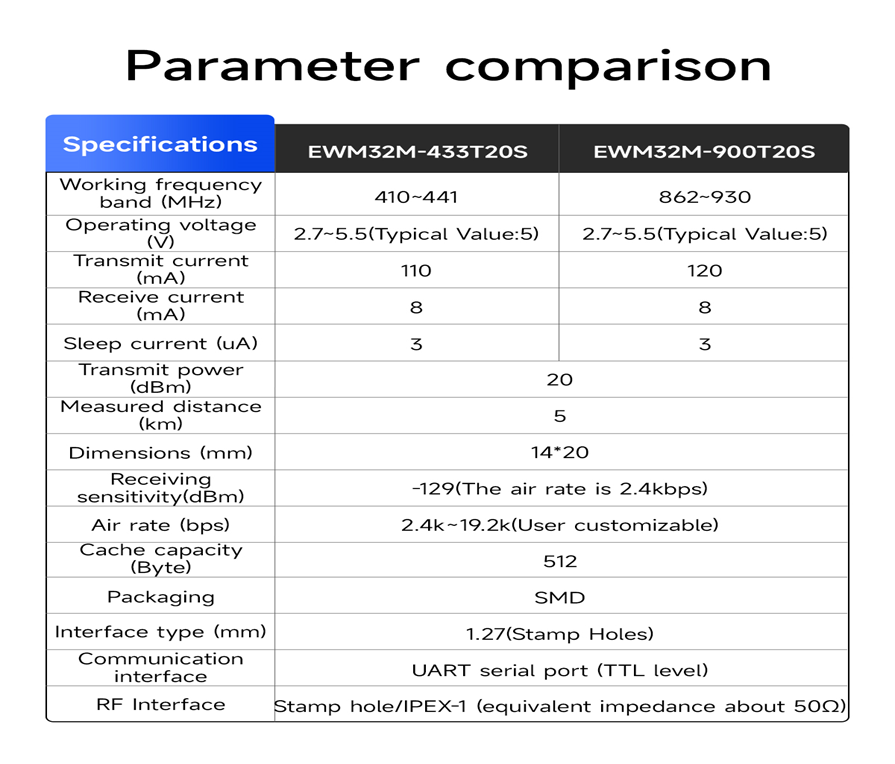
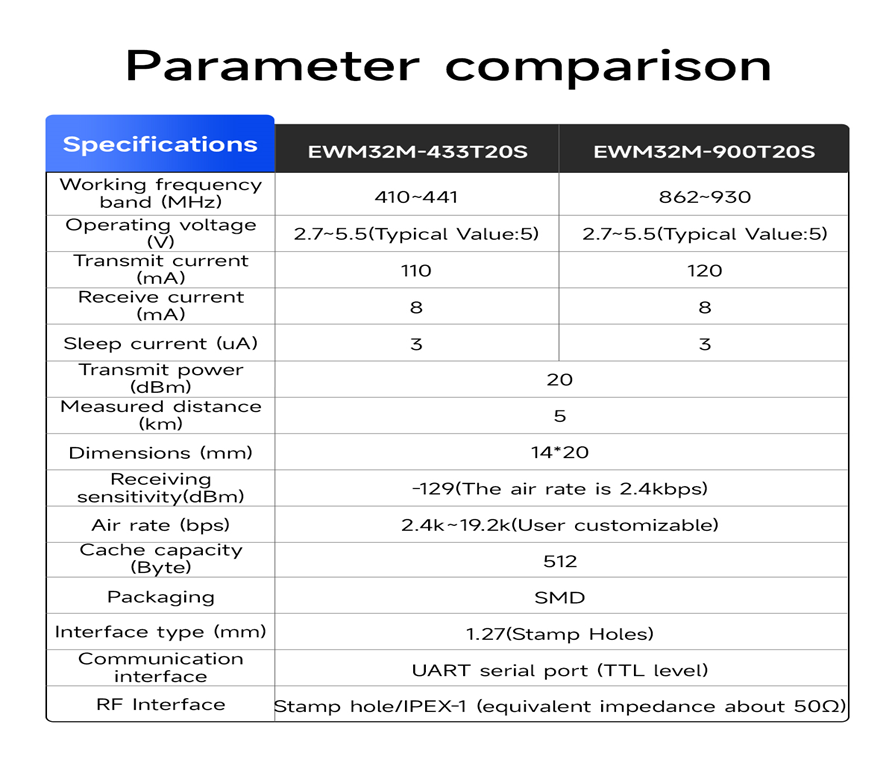
EWM32M-xxxT20S Series
Key Highlights: Ultra-small 14×20mm size, 20dBm transmit power.
Dual-band: Supports 433MHz/868/915MHz, stamp-hole surface mount package.
Power Consumption: Only 3μA in deep sleep mode, average 30μA in WOR mode.
Applications: Space-constrained embedded devices, smart city sensors.
Industrial-grade data radio
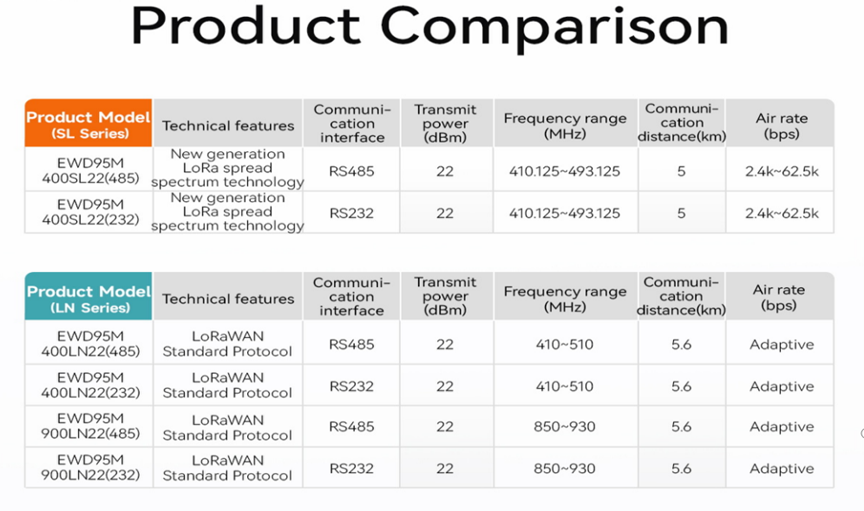
E95-DTU(900LN22-485)/E95-DTU(400LN22-485)
Interface type: RS485, industrial standard interface.
Communication distance: 5km, transmit power 22dBm.
Protection level: Contains a conformal coating.
Application scenarios: Industrial IoT device connection, long-distance RS485 data transmission.
EWD95M-900LN22(485)/ EWD95M-400LN22(485)
Interface Type: RS485/RS232 Dual Interface.
Communication Distance: 5.6km, Transmit Power: 22dBm.
Dimensions and Weight: 80×28×28.5mm, 32±2g.
Application Scenarios: Miniature rail mounting, industrial data acquisition.
Development and Test Kit
EoRa-HUB-900TB / EoRa-HUB-400TB
Chip Solution: ESP32S3+LR1121.
Communication Interface: Type-C Interface.
Features: Development and test kit integrating dual-band LoRa module + WiFi module.
Application Scenarios: Rapid prototyping, technology verification.
Purchase Recommendations
Node Type: Class A nodes are suitable for intermittent data reporting; Class nodes are suitable for applications with high real-time requirements.
Gateway Compatibility: Ensure the gateway and node module frequency bands are compatible (E870 series corresponds to E78 series).
Certification Standards: The product has passed CE/FCC/RoHS certifications and supports deployment in overseas markets.
READ MORE: Boosting Efficiency: Custom Employee-Management Software for UK Businesses
About the Author