For small commercial businesses independent retailers, cafés, salons, small offices, and serviced workspaces keeping a close eye on electricity consumption is one of the simplest ways to protect profit margins. Yet many small business owners still rely on estimated meter reads, lack visibility into their actual usage patterns, and have no reliable way to allocate energy costs between tenants or departments.
A single phase electric meter changes that entirely. Compact, accurate, and straightforward to install, single phase meters give small commercial spaces the energy data they need to monitor consumption, control costs, and stay compliant with billing requirements without the complexity or expense of industrial-grade metering solutions.
This guide covers everything you need to know about single phase electric meters for small commercial applications: how they work, the types available, how to read them accurately, and how DIN rail meters make installation simpler than ever.
What Is a Single Phase Electric Meter?
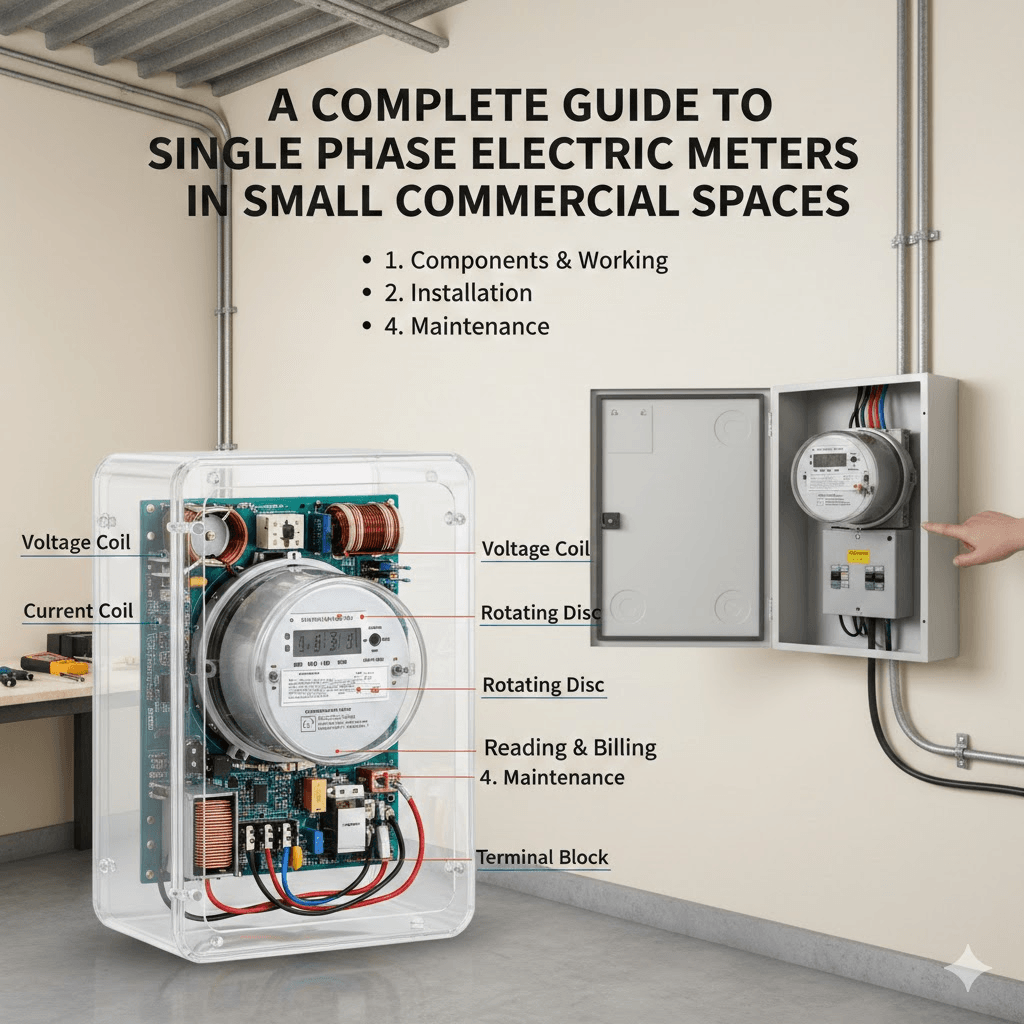
A single phase electric meter is an electronic device that measures electricity consumption in a single phase power circuit, the standard supply type for most small commercial and residential properties in the UK, typically operating at 230V via a live wire, a neutral wire, and an earth.
Unlike three-phase meters designed for high-demand industrial environments, single phase meters are purpose-built for lower-load applications. They are compact, cost-effective, and capable of measuring a comprehensive range of electrical parameters beyond basic kilowatt-hours.
Modern single phase meters can measure:
- Active energy consumption (kWh) import and export
- Reactive energy (kVArh)
- Voltage (V) and current (A)
- Active power (W) and reactive power (VAr)
- Power factor and frequency (Hz)
- Maximum demand over configurable time periods
This breadth of data makes a modern electric meter single phase far more valuable than the traditional spinning-dial meters many small businesses still have in place.
Why Small Commercial Spaces Need Dedicated Energy Metering
Many small commercial tenants or landlords assume their energy consumption is adequately covered by a supplier’s smart meter or a shared building meter. In reality, shared metering creates significant problems:
- No individual cost accountability – it’s impossible to allocate energy costs fairly between tenants or departments without individual meters
- Estimated reads lead to billing errors – without real consumption data, invoices are based on estimates that can over or undercharge
- No visibility into waste – without per-space metering, inefficiencies like equipment left on overnight or HVAC running unnecessarily go undetected
- Compliance risk for landlords – charging tenants for electricity without a MID-certified meter may not meet legal requirements for fiscal measurement
Installing a dedicated single phase electric meter for each commercial unit, office suite, or floor resolves all of these issues cleanly and cost-effectively.
Types of Single Phase Electric Meters for Commercial Use
Selecting the right meter depends on your load profile, installation environment, and monitoring requirements. Here are the main types available:
1. Direct Connect Meters
- Suitable for loads up to 100A where the main cables connect directly into the meter terminals
- Ideal for small shops, offices, and single-unit commercial spaces
- Simple wiring with no additional components required
- Available with basic pulse output or advanced Modbus/M-Bus communication
2. CT-Operated Meters
- Used where the load current is too high for direct connection, or where a non-intrusive installation is preferred
- Current transformers (CTs) clamp around the existing live cables and feed a secondary signal into the meter
- Enables metering to be added to an existing installation without interrupting the supply
- Well-suited to retrofit projects in occupied commercial premises
3. Multi-Function Meters with Serial Communication
- Measure a wide range of electrical parameters beyond kWh
- Support RS485 Modbus RTU or M-Bus communication for integration with BMS or energy management platforms
- Ideal for landlords managing multiple tenanted units or businesses wanting centralised energy reporting
- Enable automated data collection, removing the need for manual single phase electric meter reading
4. Pre-Payment Meters
- Allow landlords or property managers to set up pre-paid electricity for tenants
- Tenants top up credit before consuming electricity, eliminating debt recovery issues
- Particularly useful in short-let commercial units, co-working spaces, and serviced offices
Understanding Single Phase Electric Meter Reading
Accurate single phase electric meter reading is straightforward once you understand what the display is showing. Most modern meters cycle through their parameters automatically or allow manual scrolling via a button.
Key parameters to look out for on the display:
- kWh (Total) – the cumulative energy consumed since the meter was installed or last reset
- Import kWh – energy drawn from the grid (relevant for sites with solar generation)
- Export kWh – energy fed back to the grid from on-site generation
- kW (Active Power) – current power demand at the moment of reading
- V (Voltage) – live voltage on the circuit
- A (Current) – current draw at the moment of reading
- PF (Power Factor) – efficiency of power usage; a figure below 1.0 indicates reactive power losses
- Hz (Frequency) – should sit at or very close to 50Hz on a standard UK supply
For meters with RS485 Modbus communication, all of these parameters are transmitted automatically to a connected platform meaning single phase electric meter reading becomes entirely automated, with no manual intervention required.
DIN Rail Meters: The Ideal Format for Small Commercial Installations
DIN rail meters are the standard format for single phase energy metering in commercial distribution boards and electrical panels. The name refers to the standardised 35mm metal rail, the DIN rail onto which the meter clips securely, aligning neatly alongside circuit breakers and other panel components.
For small commercial spaces, DIN rail meters offer several clear advantages:
- Space efficiency – compact 1 or 2 module widths take minimal panel space, even in small distribution boards
- Clean installation – snap-on mounting eliminates the need for custom brackets or dedicated enclosures
- Scalability – additional meters can be added to a panel as a business grows or as new tenants move in
- Wide compatibility – DIN rail meters align directly with standard miniature circuit breakers, making them straightforward to integrate into existing panels
- Professional finish – neat panel installations with DIN rail meters are easier to inspect, maintain, and modify
For retrofit applications in occupied commercial premises, DIN rail meters, especially CT-operated variants can be added to an existing panel with minimal disruption, making them the practical choice for landlords and facilities managers working in live environments.
Key Benefits of Single Phase Electric Meters in Small Commercial Spaces
Accurate Billing and Cost Allocation
- Eliminates estimated reads and associated billing disputes
- Enables fair, usage-based cost allocation between multiple tenants or departments
- MID-certified models provide legally recognised accuracy for fiscal billing
- Supports automated invoicing when connected to energy management software
Real-Time Consumption Visibility
- Live dashboard data shows exactly how much electricity is being used and when
- Identifies high-consumption periods, idle equipment drawing standby power, and inefficient processes
- Alerts can be configured to flag unusual consumption patterns automatically
- Empowers small business owners to make informed decisions about energy use
Simplified Submetering for Multi-Tenant Properties
- Individual meters per unit allow landlords to bill tenants accurately and transparently
- Removes the administrative burden of estimating shared electricity costs
- Supports a variety of billing models including post-pay, pre-pay, and time-of-use tariffs
- Data can be aggregated across multiple units into a single energy management platform
Support for Solar and Renewable Integration
- Bidirectional models measure both imported and exported electricity
- Enables accurate tracking of solar self-consumption versus grid import
- Supports feed-in tariff reporting and on-site generation optimisation
- Essential for small commercial properties adding solar PV or battery storage systems
What to Consider When Choosing a Single Phase Electric Meter
Before specifying a meter for a small commercial application, consider the following:
- Current rating – confirm the maximum load the meter needs to handle; most direct-connect models support up to 45A or 100A
- MID certification – required if the meter will be used for billing or tenant submetering
- Communication protocol – Modbus RTU (RS485) or M-Bus for BMS integration; pulse output for basic data logging
- Display requirements – backlit LCD displays with scroll functionality make on-site reading straightforward
- Bidirectional measurement – necessary if the site has or plans to install solar PV or battery storage
- Form factor – confirm the number of DIN rail modules available in the panel before specifying the meter width
Conclusion
A single phase electric meter is one of the most practical and cost-effective investments a small commercial business or property landlord can make. By delivering accurate, real-time energy data in a compact DIN rail format, these meters provide the visibility needed to control costs, bill tenants fairly, and manage energy consumption proactively.
Whether you are metering a single retail unit, equipping a multi-tenant office building with individual submeters, or adding monitoring capability to a commercial property with solar generation, the right single phase meter properly specified and correctly installed will deliver measurable value from day one.
Frequently Asked Questions
Q1. What is the difference between a direct connect and a CT-operated single phase electric meter?
A direct connect single phase electric meter has the main load cables wired directly into its terminals suitable for loads up to 100A. A CT-operated meter uses external current transformers clamped around existing cables, feeding a secondary signal into the meter. CT models are ideal for retrofit installations where interrupting the main supply is impractical or unsafe.
Q2. How do I take an accurate single phase electric meter reading from a DIN rail meter?
Most DIN rail meters cycle through parameters automatically on their LCD display. To take an accurate single phase electric meter reading, note the kWh (total), import kWh, and current power demand (kW). For meters with RS485 Modbus communication, all readings are transmitted automatically to a connected platform eliminating manual reads entirely and reducing the risk of recording errors.
Q3. Are DIN rail meters suitable for submetering multiple tenants in a small commercial building?
Yes, DIN rail meters are the ideal format for multi-tenant submetering. Their compact module width allows multiple meters to be installed neatly within a single distribution board. MID-certified models provide legally recognised accuracy for tenant billing. When combined with RS485 Modbus communication, data from all units can be aggregated automatically into one energy management platform.
Q4. Do I need a MID-certified electric meter single phase for billing my tenants?
Yes. If you are charging tenants for electricity based on meter readings, an electric meter single phase with MID (Measuring Instruments Directive) certification is legally required. MID approval confirms the meter meets defined accuracy standards for fiscal measurement. For internal monitoring only where no billing is involved a non-MID meter is often sufficient and more cost-effective.
Q5. Can a single phase electric meter work with solar panels installed on a commercial property?
Yes, provided you select a model with bidirectional measurement capability. A bidirectional single phase electric meter records both imported energy from the grid and exported energy from your solar panels. This is essential for accurate feed-in tariff reporting, understanding how much solar generation is self-consumed, and ensuring your energy bills correctly reflect net consumption rather than gross grid draw.
About the Author